




If your agent can’t stop cleanly, it isn’t ready to run

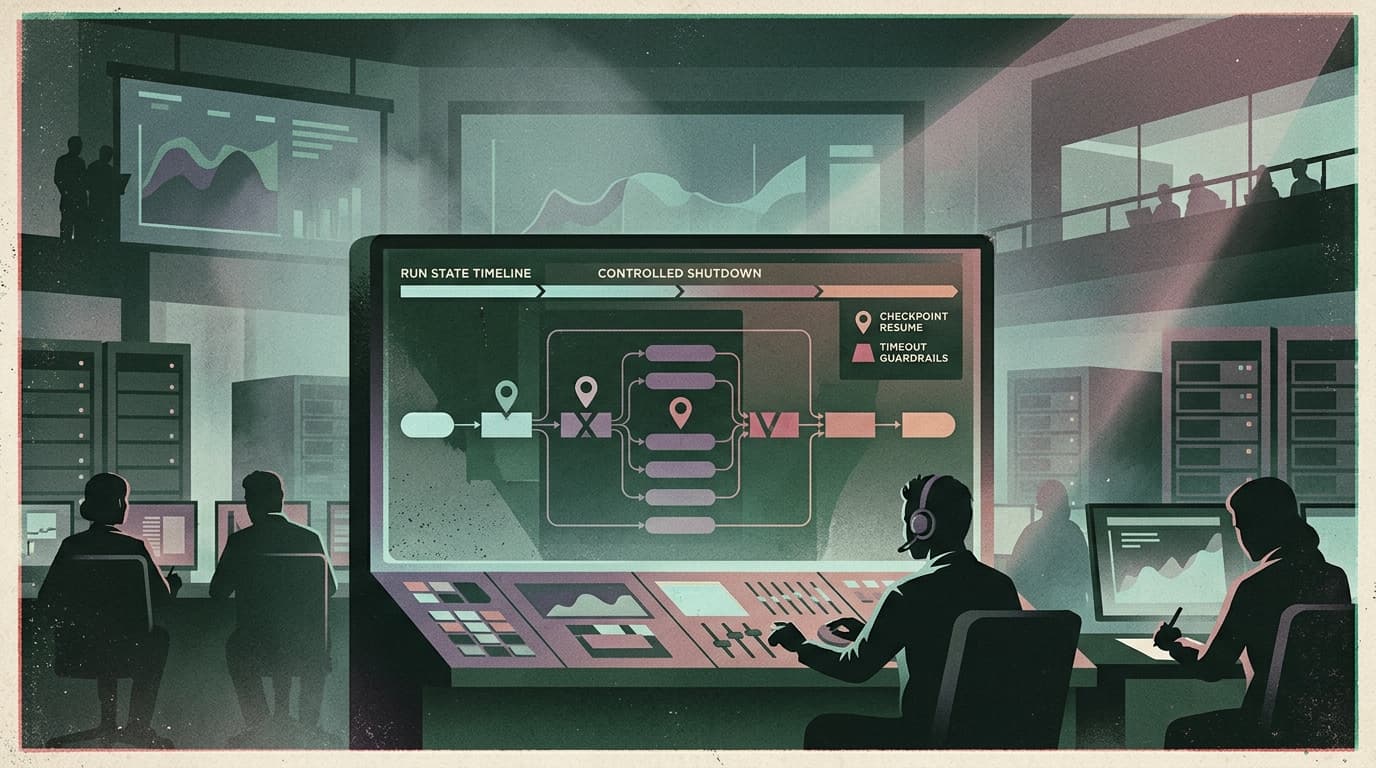
The market is done clapping for “autonomous demos.”
In the last few days, the most practical updates in the ecosystem all point the same direction: teams are investing in stop semantics for long-running agents, not just smarter generation.
If your agent can start tasks but cannot stop, drain, and resume predictably, you do not have automation. You have a background incident waiting to happen.
What changed and why it matters
Three signals converged this week:
- OpenAI’s Responses API guidance keeps pushing asynchronous background execution patterns for long-running tasks, with explicit lifecycle handling instead of fire-and-forget behavior.
- LangGraph v1.2 introduced runtime controls like per-node timeouts, graceful shutdown, and resumable checkpoints, which are operator features first and model features second.
- LangChain’s Interrupt updates reinforced the same production direction: durable execution, checkpoint efficiency, and tighter runtime governance for enterprise-scale agents.
At the same time, community threads across Reddit, LinkedIn, and X kept circling the same pain: teams can get agents to start work, but struggle to stop safely when state, cost, or policy conditions change mid-run.
That is the real bottleneck.
Main argument: stop behavior is now part of your product contract
Most teams still treat stopping as a technical edge case. It is not.
In production, stop behavior defines trust:
- Can you halt risky tool chains before external side effects land?
- Can you drain in-flight runs during deploys without corrupting state?
- Can you resume work from a known checkpoint instead of replaying chaos?
- Can operators see why a run paused, failed, retried, or exited?
If those answers are fuzzy, users will cap scope, security will block expansion, and on-call will absorb the blast radius.
The winning posture is simple: autonomy is optional, reversibility is mandatory.
Practical implications for builders, operators, and teams
Builders: Design every long-running flow with explicit run states (queued, running, paused, stopping, stopped, resuming, failed) and deterministic transitions.
Operators: Define timeout budgets and shutdown policies by workflow class, not one global default. A customer-support triage agent and a data-migration agent should not share the same kill policy.
Teams: Treat checkpoint format, retention, and replay speed as reliability KPIs. If resume takes too long or state rebuild is opaque, recovery will fail under pressure.
Product leaders: Sell “controlled execution” as value, not as internal plumbing. Buyers increasingly understand that safe stopping is what makes broad deployment possible.
Why this matters for OpenClaw users
OpenClaw gives you the runtime primitives to orchestrate real agent work: tools, sessions, memory, routing, and long-running workflows.
But runtime primitives only become deployable inside a team when stop behavior is operationally usable. That means clear controls, policy-aware interrupts, visible run state, and low-friction recovery paths.
This is where Clawpilot matters.
Clawpilot is the shell around OpenClaw that turns runtime power into operator-grade execution: managed hosting, practical control surfaces, and team-friendly workflows that make start/stop/resume behavior usable in daily operations, not just in incident mode.
Teams do not fail agent rollouts because models are too weak. They fail because operations cannot contain the run when reality changes.
Build for controlled stopping first. Everything else scales from there.